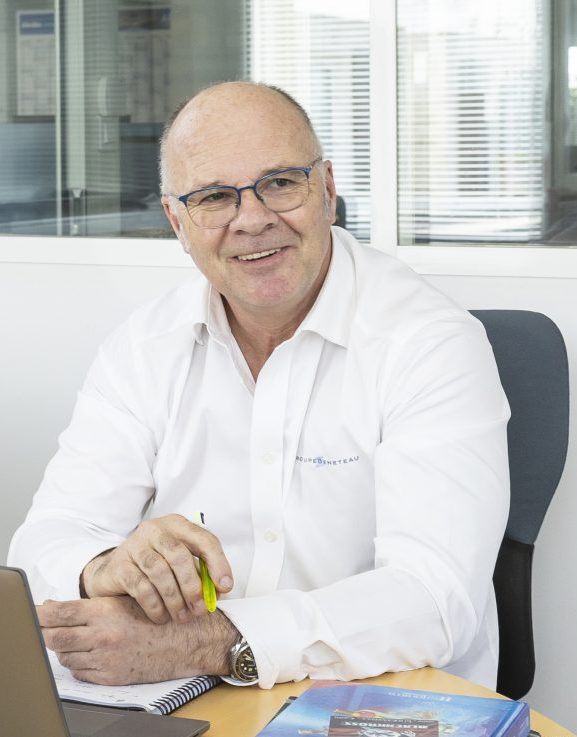
The Groupe Beneteau is accelerating its shift toward electrification. A mid technological innovations, education on new usage patterns, and industrial challenges, we sit down with Renaud Milliet, Director of Research and Development for Business Innovations, one of the experts at the heart of this transformation.
The Group is exploring several avenues to reduce the carbon footprint of its vessels. Why is electrification emerging today as the most viable solution ?
Electrification stands out as a concrete and immediately available solution. Its impact on reducing emissions is direct, as it cuts fossil fuel consumption from the very first time the vessel sets sail. But beyond the environmental aspect, it radically transforms the customer experience: sailing becomes quieter, smoother, and more comfortable. It’s an improvement in the boat’s overall performance.
What are the Group’s objectives, and how do they fit into the B-Sustainable strategy ?
Our path is clear: to reduce the intensity of our CO2 emissions by 30% by 2030. Every electrified boat sold is another step toward this goal. We aim to offer tailored solutions (100% electric, series hybrid, or parallel hybrid) across the widest possible range. However, we remain pragmatic: electrification isn’t feasible everywhere. On vessels requiring very high power and extended range, the physical limits of the battery are quickly reached.
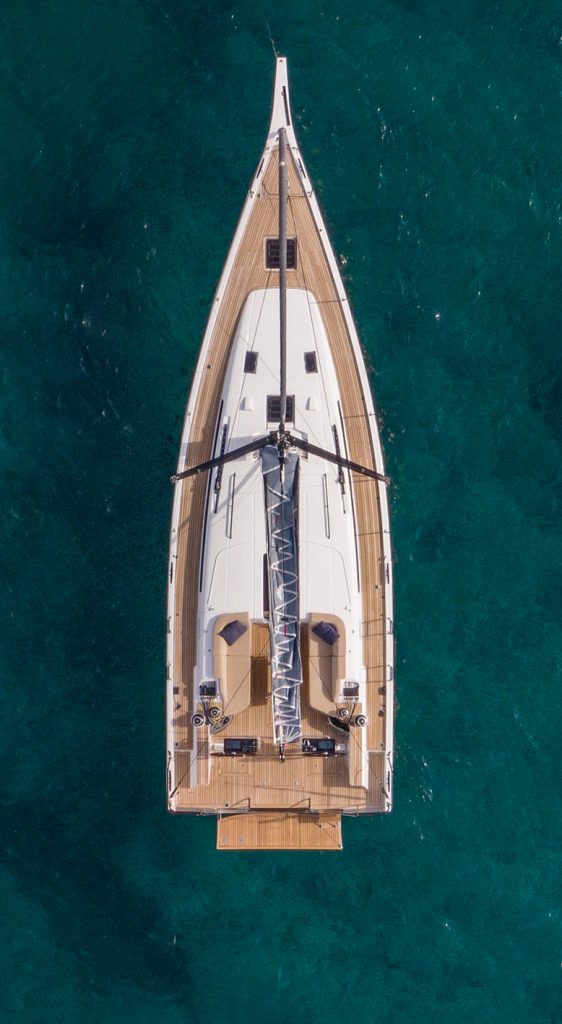
You just mentioned three options : how do you choose ?
It all depends on how you plan to use it.
All-electric models are ideal for short trips or smaller boats. Within the Group, we offer the Beneteau Océanis 30.1, the Beneteau Océanis 34.1, and the Beneteau Océanis 37.1.
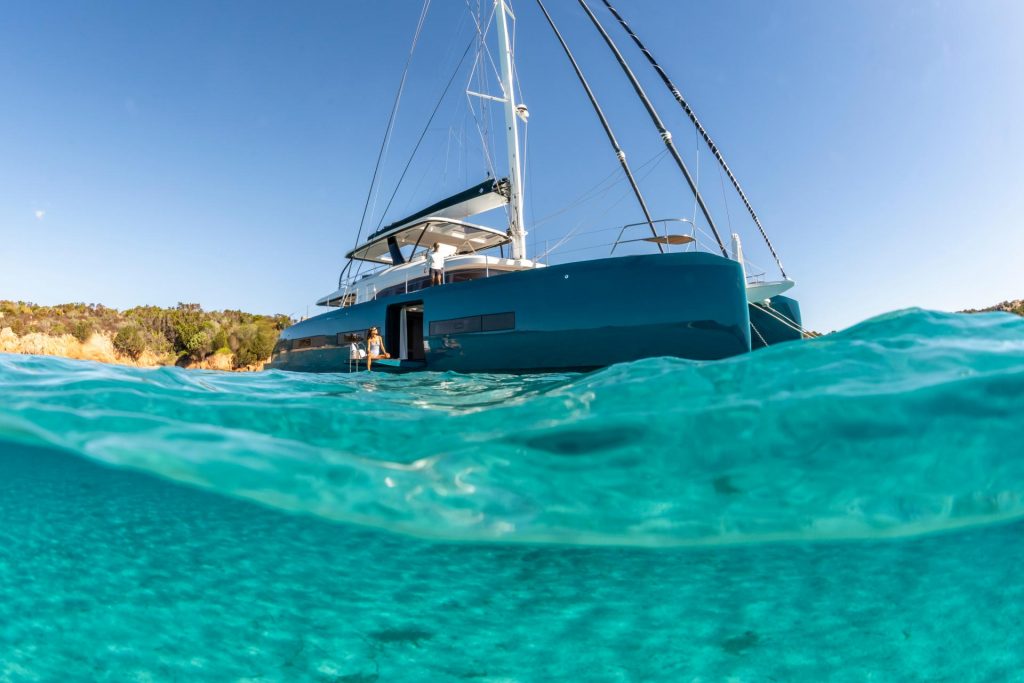
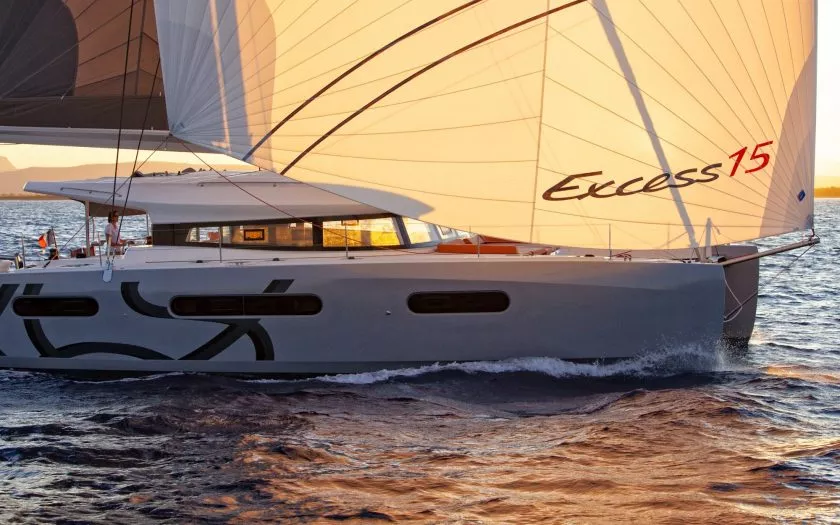
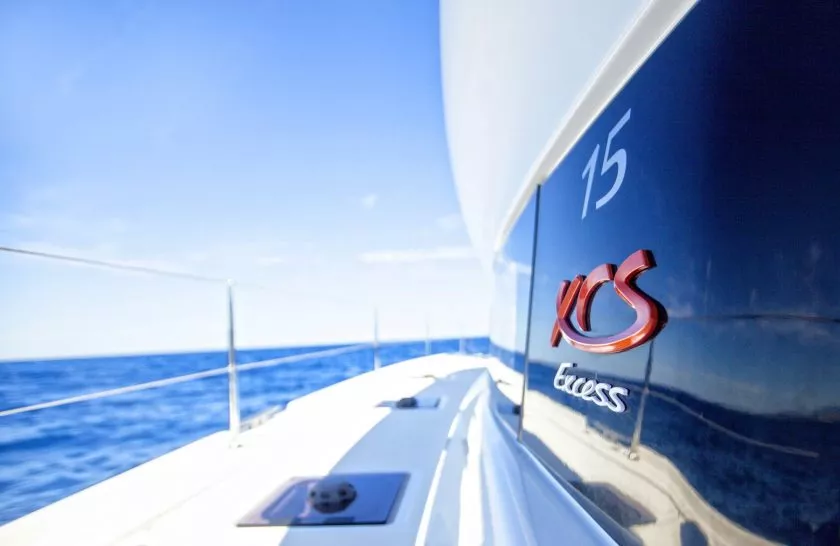
The series hybrid (an electric motor powered by batteries and a generator) is perfect for sailboats and boats up to 60 feet. Its strength lies in its ability to utilize a comprehensive energy mix—solar, wind, or hydroelectric power—to charge the batteries, with the generator (internal combustion engine) serving only as an occasional backup acting as a range extender. This is the case with the Lagoon 421, the Excess 11, the Excess 15, and the Beneteau First 44 E.
Finally, the parallel hybrid retains a mechanical connection to the combustion engine for large boats requiring power, while offering an electric mode for quiet harbor maneuvers and anchoring. I can cite the Boat, of which we manufactured 40 units.
Our role is to provide the right energy solution for the right sailing program.
Speaking of “program,” the shift to electric power seems to require a new approach to boating…
That’s the major challenge. We need to change the way people view recreational boating and guide our customers toward these new horizons. Boating with electric power means getting back to basics, especially when it comes to sailing: using the motor to leave the harbor and then letting the wind take over.
Today, recreational boaters have become more dependent on combustion engines. Switching to electric power means accepting different performance characteristics and carefully managing range.
Our mission is to convince customers that what they “lose” in speed or pure range, they gain a hundredfold in quietness and environmental friendliness.
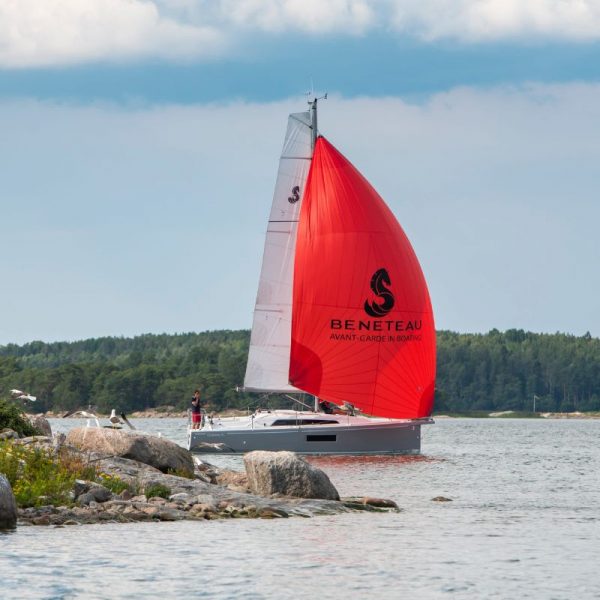
Océanis 30.1
The Group favors “low voltage” (48 V). Why this technical choice ?
For two non-negotiable reasons: safety and component availability. In wet environments, voltages above 50 V pose a real risk to human life. 48 V is the maximum voltage level to ensure safety in humid environments. It is also a system where components (batteries, motors, chargers) are available worldwide, ensuring efficient after-sales service (ASS). The transition to high voltage represents a major industrial and logistical challenge: from component manufacturing to after-sales service, to the transport of batteries by air or cargo ship, a method often refused for fire safety reasons. Internally, our teams are already mobilizing to address these technical and regulatory challenges. The goal is to ensure a transition to this technology with the highest level of reliability and safety.
What barriers still need to be overcome to make these powertrains mainstream ?
There are external barriers, such as port infrastructure, which needs to be expanded to enable fast charging. Internally, it’s a matter of skills. We need to train our employees to become true power electricians, capable of handling these complex propulsion systems. We also need to support our sales network so they can effectively market a new way of experiencing the sea, and raise awareness among our after-sales service teams. Ensuring specialized and responsive technical support is essential to reassuring our customers and sustaining this transition toward carbon-free recreational boating.
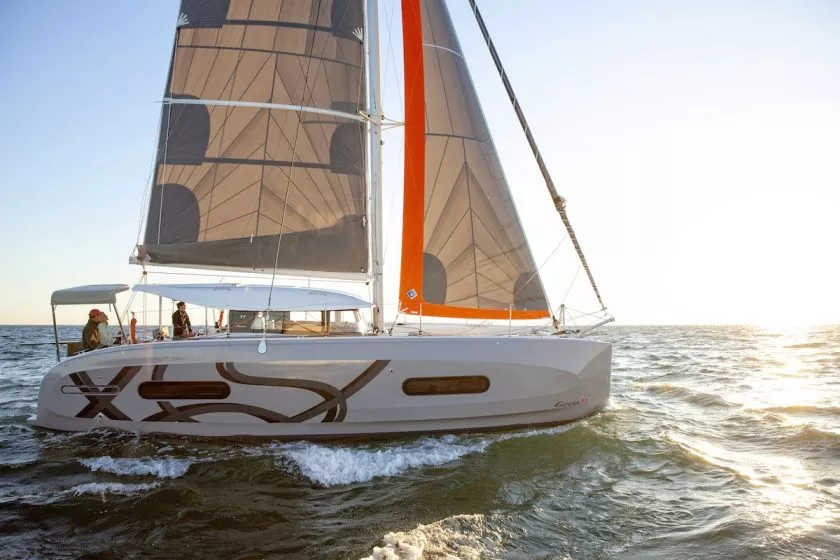
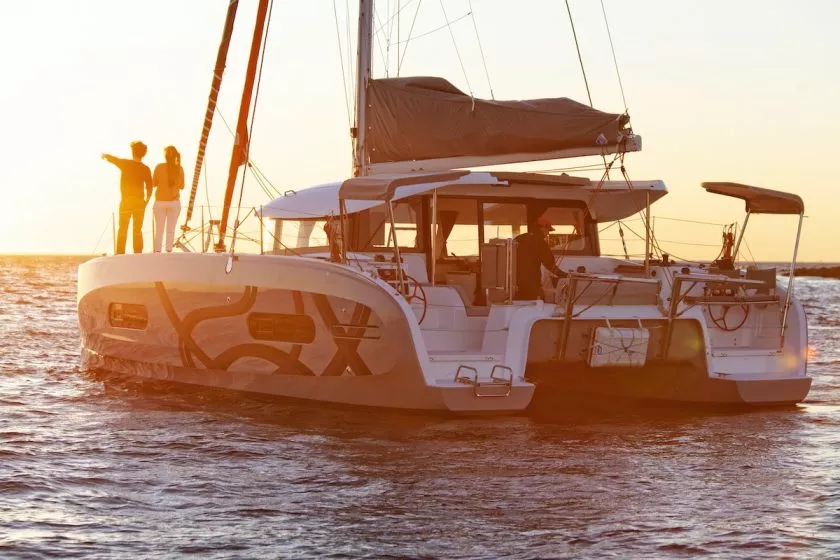
Can we really say that the plug-in hybrid has a positive carbon footprint ?
Yes, and that’s the whole point. If we simply use the internal combustion engine to charge the batteries, the system isn’t environmentally friendly. But the strength of the plug-in hybrid is that it acts as an energy hub. By connecting the system to solar panels, wind turbines, or hydrogen generation, we store “free” and clean energy. On a multi-day cruise, the overall carbon footprint is significantly lower than that of a conventional internal combustion engine. We’re no longer just consuming a single resource; we’re managing an energy mix.
What is the roadmap for 2025–2030 ?
We will expand our lineup of hybrid and electric models, as we are already doing with the Excess 11, the Excess 15, and the BENETEAU and JEANNEAU sailboats. This involves an internal transformation, as I mentioned, but also an invitation to our customers to embrace a new way of sailing. Choosing electric sometimes means accepting to slow down in order to gain a sense of calm and rediscover the pure joy of the sea.
Tried and Tested
Sailing to Île d'Yeu on the electric Oceanis 30.1, provided by the Group, was a memorable experience for the whole family. As a lifelong sailing enthusiast, I immediately loved gliding across the water, silently and without vibration, even in calm conditions. Entering the harbor in absolute silence was also a moment of pride shared with my wife and children. This technology is perfectly aligned with improving the customer experience and respecting nature: it extends the feeling of being at one with the ocean.
Clarence Duflocq, Director of Sustainable Development Coordination
Electric Propulsion : The Natural Extension of Sailing
Our EXCESS brand sees electric propulsion as the natural complement to sailing. Beyond its silence and lack of vibration, this propulsion system offers significant energy autonomy: the battery bank powers onboard amenities (induction cooktops, air conditioning, etc.). It’s essentially an electrical power plant! On our latest model, the Excess 11, the 48V series hybrid also simplifies global maintenance. Having tested it myself, the electric assist creates apparent wind in light conditions: we maintain sailing without noise. It’s sustainable sailing that has a real environmental impact.
Thibaut de Montvalon, Brand Director of EXCESS